The Visual Texture of Typography

designs by Anna Eshelman (2) and Ellen Kling for a project given by Jennifer Cole Phillips at MICA (after which this exercise was modeled) Introduction In this exercise, you will create 9 typographic compositions with 3 different sets of constraints. All nine will be within an 8-inch square, and each will contain the following texts in separate text boxes. Using InDesign, set up a 9-page document and explore the visual character of different typefaces. Use any combination of typefaces from the inside front or back cover of your textbook. (Hint: To find more fonts in the lab, open Font Book and activate fonts you would like to use. Explore the variations in texture inherent in italic vs roman forms, capital vs lowercase forms, and altering paragraph leading (linespacing). For further study see the TEXT chapter in your textbook, especially pages 81-85. Make compositions that engage the concepts of balance, tension and depth, taking special care to consider margins and internal alignments. Your text may bleed off the edges of the square. Set 1: Five justified squares (as in examples above) Set 2: Five flush left or flush right boxes (not necessarily square) Set 3: Any combination of alignments: "potluck" (see pages 84-85 in your textbook) See also below for one example of each set Here are your texts (by Paul Crowley, H.E. Chehabi, Italo Calvino, Barbara Bassett, and Adrian Searle). Copy and paste... and extra credit to those who fix the dumb quotes and em dashes (double hyphens) with their smart typographic glyphs! Scroll down for some further pointers as you work in InDesign. Have fun. The Angel-Musician invites Francis: "Listen to this music that suspends life from the ladders of heaven; listen to the music of the Invisible." And so we do. Messiaen's unique musical signature comes into full play in "The Sermon to the Birds," the sixth tableau. It is the synthesis of his personal vision: the spiritual apex of Francis's earthly life, the heavenly "music" to which he was attuned, and Messiaen's own love for bird song (he was a well-traveled ornithologist who recorded bird sounds). The longest scene in the opera, it may be the most transcendent. Human voices give way to a glittering cacophony of bird voices that become interlocking and shifting polytonal structures, punctuated by seemingly chance atonal effects, something like an aural rendering of a Jackson Pollock painting, in seventy-five staves! The effect is ethereal, the action on stage stops, and for a moment we are lifted out of the opera itself. At this point I simply closed my eyes. The Koran explicitly forbids the consumption of only three things: pork, alcohol, and carrion. The consumption of pork and alcohol was indeed outlawed soon after the revolution of 1979, there being no need to prohibit carrion since Iranians are not particularly fond of it. Caviar, however, posed a delicate problem. Shiite jurisprudence considered it haram (forbidden), but since its production and export were a state monopoly, caviar procured the Iranian treasury millions of dollars in revenue. Trading in what is forbidden being equally forbidden under the shari'a, the Islamic Republic faced the alternative of either reneging on its promise of applying divine law or depriving itself of valuable export earnings. Moreover, caviar is the epitome of luxury and culinary refinement in Western culture,4 which alone must have rendered it suspect in the eyes of the populists who took power soon after the revolution. To find a way out of this dilemma, the status of caviar under religious law was revisited. At the end of a laborious process involving both clerics and fisheries experts, the traditional ruling was reversed, and caviar was declared halal (permitted). Finally the journey leads to the city of Tamara. You penetrate it along streets thick with signboards jutting from the walls. The eye does not see things but images of things that mean other things: pincers point out the tooth-drawer's house; a tankard, the tavern; halberds, the barracks; scales, the grocer's. Statues and shields depict lions, dolphins, towers, stars: a sign that something--who knows what--has as its sign a lion or a dolphin or a tower or a star. Other signals warn of what is forbidden in a given place (to enter the alley with wagons, to urinate behind the kiosk, to fish with your pole from the bridge) and what is allowed (watering zebras, playing bowls, burning relatives' corpses). From the doors of the temples the gods' statues are seen, each portrayed with his attributes--the cornucopia, the hourglass, the medusa--so that the worshipper can recognize them and address his prayers correctly. If a building has no signboard or figure, its very form and the position it occupies in the city's order suffice to indicate its function: the palace, the prison, the mint, the Pythagorean school, the brothel. The wares, too, which the vendors display on their stalls are valuable not in themselves but as signs of other things: the embroidered headband stands for elegance; the guilded palanquin, power; the volumes of Averroes, learning; the ankle bracelet, voluptuousness. Your gaze scans the streets as if they were written pages: the city says everything you must think, makes you repeat her discourse, and while you believe you are visiting Tamara you are only recording the names with which she defines herself and all her parts. The common morel (Morchella esculenta): When young, this species has white ridges and dark brown pits and is known as the "white morel." As it ages, both the ridges and the pits turn yellowish brown, and it becomes a "yellow morel." If conditions are right the "yellow morel" can grow into a "giant morel," which may be up to a foot tall. The black morel or smoky morel (Morchella elata): The ridges are gray or tan when young, but darken with age until nearly black. The pits are brown and elongated. These morels are best when picked young; discard any that are shrunken or have completely black heads. The half-free morel (Morchella semilibera): This is the exception to the rule that morels have the bottom of the cap attached directly to the stem. The cap of the half-free morel is attached at about the middle (see illustration). These morels have small caps and long bulbous stems. Pursued for over a quarter of a century, Serra's work has been a honing-down of what sculpture is, could be and might be. His sculptural syntax is narrow, his vocabulary of forms is, in several senses, truncated, and even his repertoire of materials is limited. But these are the limits he enjoys working against, if 'enjoy' isn't too frivolous a verb. What, in a lesser artist, would make for a very boring career, lends his work unusual authority and gravitas. Improvising, for Serra, means bringing his own constraints to bear against the unique situation of each show, and in particular the constraints of the site itself. This isn't only a matter of staging the work, the choreography of materiality, volume and mass, within a given space. Serra is, equally, choreographing space itself, dramatising it, condensing and expanding it. For Serra, space is more malleable than metal. His sculptural concerns would be traditional enough, were it not for the extreme degree to which he challenges the materiality and even fabric of the museum, our expectations of public space, and the ways in which we occupy it. He puts even the architecture around his work under duress. Perhaps it is in recognition of this that Serra has earned a wary respect, and a rota of almost annual museum shows and public commissions to prove it. His work endures in a peculiar way. more designs! from left to right: justified, flush left & right, and potluck! 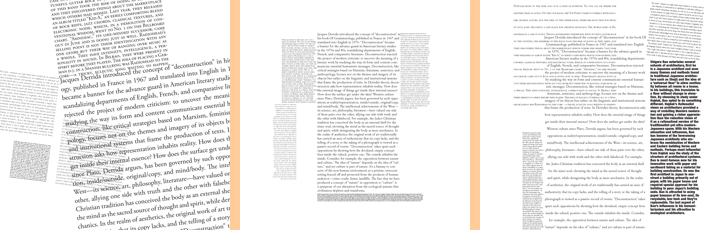
designed by me! InDesign pointers: Holding the shift key will constrain a box of type to a square (or, if already drawn, to its existing proportions). Type will stay the same scale within a type box unless you hold down the shift and open apple keys down simultaneously as you click and drag a corner of the box. Use the Find/Change operation under Edit to change all double spaces to single spaces, double hyphens to em dashes (option-shift-hyphen), and to use smart quotes and ligatures. Most of the operations you will need are under the Character and Paragraph panes. Put a hairline (.25 pt) stroke on an 8-inch box on the master page so when you print, your compositions will have a clear designed edge. |